
 English
 العربية
 ไทย
ไทย Indonesia

limpieza ultrasónica
Ultrasonic cleaning is a modern and efficient method used to remove contaminants from a wide variety of objects and materials. It relies on high‑frequency sound waves, typically in the range of 20–80 kHz, transmitted through a liquid to create millions of microscopic bubbles. These bubbles form and collapse in a process known as cavitation. When they implode near the surface of an item, they generate tiny shock waves and micro‑jets that dislodge dirt, grease, oxides, and other residues, even from very small gaps and complex geometries.A typical ultrasonic cleaning system consists of a tank, a transducer, a generator, and a suitable cleaning solution. The tank holds the liquid and the parts to be cleaned. The transducer converts electrical energy into ultrasonic vibrations and is either mounted on the tank wall or immersed in the liquid. The generator provides the required electrical signal at the desired frequency and power. The cleaning solution can be plain water, water with detergents, or specially formulated solvents, depending on the type of soiling and the material of the workpiece.One of the key advantages of ultrasonic cleaning is its ability to reach areas that are inaccessible by manual cleaning methods, such as blind holes, fine channels, and internal cavities. The process is gentle enough for delicate components, yet powerful enough to remove stubborn contaminants. It is widely used in industries such as electronics, medical and dental, automotive, aerospace, precision engineering, and jewelry. Typical applications include cleaning circuit boards, surgical instruments, fuel injectors, bearings, optical lenses, and watch parts.Process parameters such as frequency, temperature, cleaning time, and chemistry must be optimized for each application. Lower frequencies generally produce larger cavitation bubbles and stronger cleaning action, which is suitable for robust parts with heavy contamination. Higher frequencies generate smaller bubbles and a more delicate action, ideal for fine or sensitive components. Heating the solution, usually to 40–70°C, improves chemical activity and helps dissolve oils and greases. Cleaning cycles can range from a few minutes to over half an hour, depending on the level of contamination.Ultrasonic cleaning also offers environmental and economic benefits. It reduces the need for harsh chemicals and manual scrubbing, lowers labor costs, and can improve consistency and quality. With proper filtration and maintenance of the cleaning solution, bath life can be extended, minimizing waste. However, safety considerations are important: operators should avoid direct contact with the liquid during operation, use appropriate chemistry for the materials involved, and ensure adequate ventilation when volatile agents are present.Overall, ultrasonic cleaning provides a highly effective, time‑saving, and versatile solution for both industrial and laboratory cleaning tasks, delivering thorough results that are difficult to achieve by conventional methods.
Producto
Categoría:
-
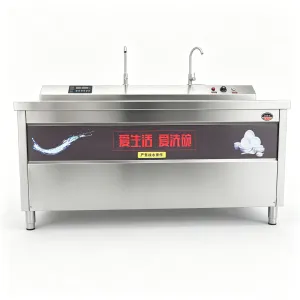
Lavavajillas ultrasónicos de acero inoxidable para restaurante y catering
Su clasificación: Serie de lavavajillasVistas: 11Número:Tiempo de liberación: 2026-04-17 15:45:13Este lavavajillas ultrasónico de acero inoxidable utiliza ondas de alta frecuencia para una limpieza profunda, elimina aceite y residuos de manera eficiente, ahorra agua y detergente y está construido para ser resistente para uso en restaurantes y catering de gran volumen.
Noticias
Categoría:
¡Sin resultados de búsqueda!
Caso
Categoría:
¡Sin resultados de búsqueda!
Video
Categoría:
¡Sin resultados de búsqueda!
Descargar
Categoría:
¡Sin resultados de búsqueda!
Reclutamiento
Categoría:
¡Sin resultados de búsqueda!
Productos recomendados
¡Sin resultados de búsqueda!



 Whatsapp
 Teléfono